Updated May 2026. By the SkyIndoFly Editorial Team. Reviewed for Umrah-corridor logistics — see Editorial Standards.
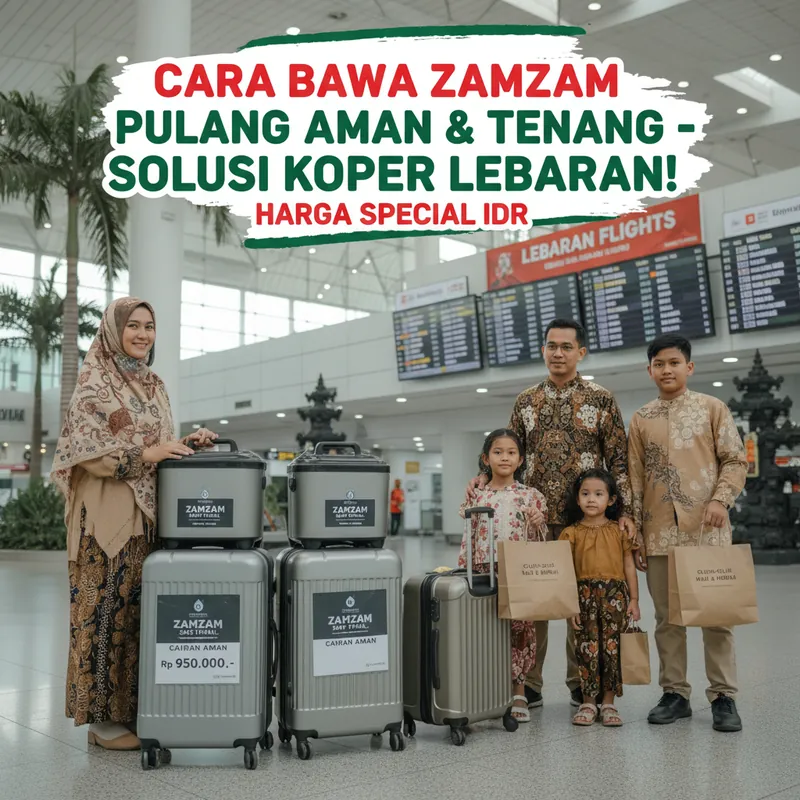
Zamzam water may be carried home as check-in baggage up to 5 liters per pilgrim on Umrah flights, but the risk of breakage during baggage handling is real: hold compression, carousel slams, and extreme weather can crack plastic jerry cans. Per the IATA Dangerous Goods Regulations 2026 edition, zamzam water is not dangerous goods — restrictions are operational and tied to official Saudi government packaging, not security. This guide sets out 7 technical steps for packing 5 liters in a hard-case suitcase with plastic wrap, heavy-duty double-bag, clothing padding, photo documentation, and a claim procedure if the container breaks — total packing time 40–45 minutes per container.
A brief note on transparency. When you click through our
/go/links to Aviasales, we earn a small commission at no extra cost to you. We are not paid more for one airline over another; we recommend official fares that you can verify independently. Aviasales prices match airline direct prices.
Disclaimer. This article is not a religious fatwa. For questions of religious interpretation, consult MUI / a qualified ustadz / a certified KBIHU. For the official PPIU list, see Kemenag SISKOPATUH. Airline rules and travel-insurance clauses may change — verify directly on each airline’s official site and on your insurance policy before departure.
At a glance: 7 packing steps and total time
For first-time pilgrims, there are 7 packing steps to complete at the hotel before leaving for the airport. The summary table presents the estimated time, primary supplies, and purpose of each step (May 2026):
| # | Step | Time | Primary Supplies | Purpose |
|---|---|---|---|---|
| 1 | Collect the official well-zamzam container | 30–60 min | Queue at Kudai/Madinah filling stations | Official packaging with Arabic + English label |
| 2 | Inspect seal, label, physical condition | 5 min | Visual inspection | Prevent rejection at the baggage counter |
| 3 | Plastic wrap + heavy-duty double-bag | 10–15 min | Plastic wrap, 60L heavy-duty bags ×2 | Leak-proof layer |
| 4 | Place at the center of the suitcase with padding | 10 min | 24–28 inch hard-case, clothing as padding | Prevent compression and impact |
| 5 | Bubble wrap + FRAGILE labels | 5 min | Bubble wrap, FRAGILE labels, duct tape | Shock absorber + handling signal |
| 6 | Pre-check-in photo documentation | 5 min | Smartphone, cloud storage | Proof of original condition for claims |
| 7 | Claim procedure if the container breaks | 30–60 min (if needed) | PIR at Lost & Found, pre-check-in photos | Airline/insurance replacement |
| TOTAL packing | 40–45 min |
The total above excludes the container pickup in Makkah/Madinah (typically done 1–2 days pre-departure) and claim time. Estimated cost of packaging materials: Rp 150,000–Rp 350,000 per pilgrim (plastic wrap Rp 30,000, heavy-duty bags Rp 25,000, bubble wrap Rp 35,000, duct tape Rp 15,000, FRAGILE labels Rp 10,000, optional additional official containers SAR 5–15).
IATA context: why zamzam is not dangerous goods but is still capped
Per the IATA Dangerous Goods Regulations 2026 edition, dangerous goods are items that can endanger flight safety because of their chemical or physical properties — flammables (Class 3), radioactive materials (Class 7), pressurized gases (Class 2), corrosives (Class 8), and so on. Ordinary mineral water, including zamzam, is not in this classification because it is pH-neutral, non-flammable, non-corrosive, and non-pressurized.
So why the 5-liter cap? The cap is operational, not security-driven: (1) aircraft weight & balance — Umrah-charter aircraft carry hundreds of pilgrims, and 10–20 liters per pilgrim would add 2–5 tons of load affecting fuel burn and flight trim; (2) hold capacity — the aircraft hold has finite volumetric capacity; (3) airline dispensation policies — Saudia (Conditions of Carriage Article 9.2), Garuda Indonesia, Lion Umrah Service, Citilink, Emirates, Etihad, Qatar Airways, Oman Air, and Gulf Air all set 5 liters as the dispensation standard. Flynas and AirAsia provide no dispensation — zamzam is counted as standard check-in liquid. For a detailed 12-airline comparison, see the 12-airline zamzam baggage table with IDR excess fees.
The Saudi government, through the General Authority of Civil Aviation (GACA), requires zamzam carried home to be in official sealed packaging identifiable as a zamzam-well product — not in regular mineral-water bottles or local jerry cans. Umrah-corridor airlines adopt this rule as the condition for the 5-liter free dispensation.
Official packaging vs local jerry can vs mineral bottle: three options, one right choice
Many first-time pilgrims ask: can I buy a plastic jerry can at a Makkah market and fill it at Masjid al-Haram? Or use a 1.5-liter mineral-water bottle I already have? Here is a comparison against the official policies of Saudia, Garuda Indonesia, and Lion Umrah Service:
| Packaging Option | Official Label | Accepted for Dispensation | Risk at Baggage Counter | Handling Durability |
|---|---|---|---|---|
| Official well-zamzam container (5L blue jerry can / white drum) | Yes (Arabic + English, factory seal) | Yes, 5 liters free | Low | High (thick walls, factory seal) |
| Local plastic jerry can from Makkah market | No | Not automatic (risk of rejection or counted as standard liquid) | High | Medium (thin walls, manual seal) |
| 1.5-liter mineral water bottle (PET) | No | No (counted as standard check-in liquid, no dispensation) | Medium (still allowed but no free dispensation) | Low (thin PET, prone to cracking) |
| Dedicated zamzam-koper with internal container | Depends on contents (must have official container inside) | Depends on contents | Low if official container inside | Very high |
The official well-zamzam container is available free of charge to registered Umrah pilgrims at the Kudai Distribution Center in Makkah and Madinah filling stations. Additional containers cost SAR 5–15 (~Rp 21,000–Rp 63,000) each. It carries an Arabic + English label reading “ZamZam Water — Kingdom of Saudi Arabia,” a factory-applied screw cap with tamper-evident plastic, and thick HDPE walls engineered for cargo handling.
Local plastic jerry cans are widely sold at Souk Al-Diyafa or around Masjid al-Haram for SAR 10–30 (~Rp 42,000–Rp 127,000) per 5-liter can. They look similar but lack the well-zamzam label and have thinner walls. Airlines may refuse them or count them as standard check-in liquid without the 5-liter dispensation — meaning the full weight counts against your baggage quota.
1.5-liter mineral-water bottles (PET) are not recommended at all. Thin PET walls are prone to cracking under hold compression, and the lack of label automatically excludes the dispensation. If used, treat them as a backup for small volumes (1–2 liters as a souvenir for close family), pack them in a heavy-duty bag with extra padding, and accept that there will be no free dispensation.
For airline-by-airline policy detail including Flynas which provides no dispensation, see the 12-airline zamzam baggage table.
Steps 1–2 — Collect the official container and inspect the condition (35–65 minutes)
Official Saudi government packaging is available at the Kudai Distribution Center in Makkah (about 5 km from Masjid al-Haram, open 24 hours) and Madinah filling stations around Masjid an-Nabawi. Bring your passport for Umrah-pilgrim verification. Official allocation: 1 free 5-liter container per registered pilgrim; additional containers cost SAR 5–15 (~Rp 21,000–Rp 63,000). Do the pickup 1–2 days before departure; PPIU pilgrims are typically served via a collective pickup arranged by the coordinator.
Before leaving the station, do a visual check: (a) cap seal intact without cracks, (b) the “ZamZam Water — Kingdom of Saudi Arabia” Arabic + English label readable, (c) no leak at the bottom or sides, (d) no hairline cracks on the plastic surface. If any defect is found, exchange it on the spot. Airlines may refuse defective containers — not for religious reasons but because they fail the airline dispensation standard and IATA cargo-handling standard.
Step 3 — Plastic wrap and double-bag in the hotel room (10–15 minutes)
Prepare cling film and 2 heavy-duty 60-liter plastic bags. Cling film is sold at Makkah/Madinah supermarkets (Bin Dawood, Panda, Tamimi) at SAR 8–15 (~Rp 34,000–Rp 63,000) per 30-meter roll. Heavy-duty 60-liter bags cost SAR 5–10 (~Rp 21,000–Rp 42,000) per pack of 5.
Three-layer procedure: (1) wrap the container with at least 3 full layers of cling film, focusing on the screw cap and the seam between cap and body; (2) place it in the first heavy-duty bag, tie with a twist + double-knot; (3) place it in a second heavy-duty bag with the orientation reversed (first bag opening at the bottom of the second bag) for redundancy. Ensure no air is trapped — air expands at low pressure in the hold and can rupture the bag. The goal: if the container cracks during handling, liquid is contained between two bag layers and will not soak clothing, documents, or the suitcase.
Step 4 — Center the container in a hard-case suitcase with clothing padding (10 minutes)
Choose a hard-case suitcase 24–28 inches in polycarbonate or ABS. Popular brands in Indonesia: Polo (Rp 800,000–Rp 1,500,000), American Tourister (Rp 1,500,000–Rp 3,000,000), Samsonite (Rp 2,500,000–Rp 5,000,000). Budget alternative: dedicated zamzam-koper with pre-padded internal compartment at Umrah outfitter shops for Rp 250,000–Rp 500,000.
Layout: 1–2 folded layers of clothing as a base (do not place the container at the bottom — the underside is most vulnerable to carousel impact); the double-bagged container at the center with label facing up (label-up for X-ray inspection ease); at least 2 layers of clothing as padding on all four sides (ihram, sarong, towels work best); 1–2 layers of clothing as top cover before bubble wrap. Avoid: electronics near zamzam (laptops/phones can be damaged if liquid seeps); overstuffing (compression can press the container); pressurized liquid souvenirs (liquid dates, honey, olive oil) that can knock against each other.
Step 5 — Bubble wrap, FRAGILE labels, and lock the suitcase (5 minutes)
Layer 1–2 meters of bubble wrap on top of the container as an extra shock absorber. Bubble wrap is sold at Makkah/Madinah supermarkets for SAR 10–20 (~Rp 42,000–Rp 84,000) per 5-meter roll. Place “FRAGILE — Liquid: ZamZam Water” labels on four sides of the suitcase (top near the handle, bottom near the wheels, left and right large panels). Saudia and Garuda provide dedicated zamzam labels at the counter on request; Lion Umrah Service and Citilink supply generic FRAGILE stickers. Print your own bilingual labels at a hotel print shop (“FRAGILE — LIQUID — ZamZam Water” / “RAPUH — CAIRAN — Air Zamzam”) for maximum readiness.
Lock with a wire padlock for Saudi transit (TSA-locks are not required in KSA/UAE/Qatar). Total final weight of container + wrap is about 6–7 kg for 5 liters; with clothing and souvenirs, an Umrah suitcase typically reaches 22–28 kg — still within the 30 kg standard check-in quota on Saudia, Garuda, and Emirates Special Fare Umrah. Weigh with a portable scale (Rp 50,000–Rp 150,000) at the hotel to avoid counter overweight fees (Rp 200,000–Rp 400,000 per kg).
Step 6 — Pre-check-in photo documentation (5 minutes)
Take at least 4 smartphone photos: (1) intact container with label and seal visible (timestamp active); (2) open suitcase showing container centered with padding; (3) closed suitcase with FRAGILE labels on four sides; (4) baggage tag after check-in. Upload to Google Drive, iCloud, or Dropbox with timestamps — do not rely on the phone gallery alone. Note the baggage tag and flight number in phone notes as backup. These cloud photos + tag number are the primary evidence for any claim if the container breaks.
Step 7 — Claim procedure if the container breaks at Soekarno-Hatta
If your suitcase arrives at the carousel with visible wetness, the distinctive zamzam smell, or dripping liquid, do not pick it up. Ask Saudia/Garuda/Lion Umrah Service ground staff in international arrivals to open the suitcase in front of you. They have an SOP for broken-container incidents.
File a Property Irregularity Report (PIR) at Lost & Found on the Terminal 3 international arrivals floor. Bring: passport, boarding pass, baggage tag, and the pre-check-in cloud photos. Show the photos as proof of the original condition — the damage occurred during airline handling. Request an official PIR copy with its unique reference number for follow-on claims.
Three claim pathways by pilgrim profile:
- PPIU-registered: Coordinate with the PPIU coordinator who holds a collective travel insurance policy. Standard reimbursement is Rp 500,000–Rp 2,000,000 per incident, processed in 7–21 working days by Allianz Travel, AXA, Zurich, ACA, or a local provider.
- Independent Umrah without insurance: File the claim directly with the airline. Saudia (Conditions of Carriage Article 12) and Garuda Indonesia offer limited container-replacement dispensation on Umrah-charter flights — typically a new zamzam container or a future-flight voucher, not cash.
- PMI doing Umrah on a personal trip: BPJS-PMI does not cover baggage damage (BPJS-PMI focuses on work, health, and accident protection). Use separate travel insurance from a PPIU or an independent provider — premium Rp 100,000–Rp 350,000 per 12-day Umrah trip.
For a full guide to Umrah paperwork including insurance, see the 8-step independent Umrah paperwork guide.
Alternative: ship zamzam via air cargo if your baggage quota is full
For pilgrims carrying more than 5 liters (10–15 liters for extended family, or Flynas/AirAsia pilgrims without a dispensation), air cargo is a viable option. Several PPIUs and Saudi cargo agents offer this service:
| Zamzam Cargo Service | Volume | Shipping Fee | Estimated Delivery | Notes |
|---|---|---|---|---|
| Collective PPIU cargo (Umrah-charter package) | 5–10 L | Rp 250,000–Rp 400,000 | 7–14 working days | Includes official packaging + shipping insurance |
| Independent Saudi cargo agent (Saudi Post, Aramex) | 5–30 L | Rp 350,000–Rp 800,000 | 5–10 working days | Hotel pickup or drop at agent office |
| Garuda Cargo / Saudia Cargo (Jeddah to CGK/SUB) | Min 10 L | Rp 80,000–Rp 150,000 per kg | 3–7 working days | Requires recipient declaration in Indonesia |
Note three points: (a) packaging must be the official well-zamzam container — commercial cargo requires it for labelling and customs declaration at Soekarno-Hatta; (b) at Soekarno-Hatta customs, zamzam falls under personal effects for Umrah pilgrims and is not subject to import duty as long as the volume is reasonable (< 30 liters per shipment), per PMK 203/2017 / PMK 34/2025 at Customs; (c) shipping insurance worth Rp 500,000–Rp 2,000,000 should be bundled with the cargo service to protect against breakage in transit. For pilgrims combining Umrah with other international routes (e.g., return via Turkish Airlines transit Istanbul), consider a separate cargo option because IST has no zamzam dispensation from non-Gulf carriers — see the Umrah transit Dubai vs Doha vs Istanbul guide.
FAQ: first-time-pilgrim questions about packing zamzam
Why is zamzam capped at 5 liters if it is not dangerous goods? The cap is operational — aircraft weight-and-balance distribution, hold capacity for hundreds of pilgrims per Umrah-charter flight, and airline dispensation policies. Zamzam is chemically identical to ordinary mineral water and is not classified as IATA dangerous goods. The excess beyond 5 liters is charged at Rp 80,000–Rp 200,000 per kg.
Can I use a regular jerry can or mineral bottle? Not recommended. Saudia, Garuda, Lion Umrah Service, and Citilink require official Saudi government packaging with the well-zamzam label in Arabic + English for the free dispensation. Unofficial packaging risks rejection at the counter or counting as standard check-in liquid without dispensation.
What type of suitcase is safest? A hard-case (polycarbonate or ABS) 24–28 inches provides the best protection. Dedicated zamzam-koper with pre-padded internal compartments are available at Umrah outfitter shops for Rp 250,000–Rp 500,000. Soft-case suitcases are less ideal because they can absorb liquid if the container leaks.
Can I wrap the container in my ihram garment? Yes, as additional padding, but the primary wrap must still be plastic wrap and a heavy-duty double-bag for the leak-proof layer. The order: plastic wrap first, then double-bag, then clothing/towel as outer padding.
What should I do if the container breaks at Soekarno-Hatta? Do not pick the suitcase up from the carousel if it looks wet. Ask airline staff to open the suitcase in front of you and file a PIR at the Terminal 3 Lost & Found counter. Attach the pre-check-in cloud photos as proof of the original condition.
Does Umrah travel insurance cover a broken zamzam container? Most Umrah-charter travel insurance policies cover baggage damage including a broken zamzam container at Rp 500,000–Rp 2,000,000 per incident. BPJS-PMI does not cover baggage damage — use separate travel insurance from a PPIU or independent provider.
How long does packing take? Total 40–45 minutes per 5-liter container. Do this at least 12–24 hours before leaving the hotel.
Can zamzam be shipped via air cargo if my baggage is full? Yes. PPIUs and Saudi cargo agents offer shipping at Rp 350,000–Rp 800,000 per 5 liters from Jeddah to Jakarta/Surabaya/Makassar, estimated 5–10 working days. Useful for Flynas/AirAsia pilgrims without dispensation or for those carrying more than 10 liters.
Compare official Umrah-airline fares
To compare official airline fares including excess-baggage fees if you plan to carry more than 5 liters of zamzam, we provide live price-comparison links via Aviasales. The prices shown match airline direct prices.
- Compare Jakarta–Jeddah (CGK–JED) fares on Aviasales — Saudia, Garuda, Lion Air, Emirates, Etihad, Qatar Airways
- Compare Surabaya–Jeddah (SUB–JED) fares on Aviasales — Saudia, Garuda, Lion Air, Citilink charter
- Compare Jakarta–Madinah (CGK–MED) fares on Aviasales — Saudia direct to Madinah, Lion Air, Garuda
Related guides
- 12-airline zamzam baggage table with IDR excess fees — Per-airline policy: Saudia 5L, Garuda 5L charter, Lion Umrah Service bundle 30 kg + 5L, Flynas 0L.
- 8-step independent Umrah paperwork guide — End-to-end worked example from passport to in-Saudi transport.
- Ramadhan 2026 Umrah pricing per week — Aggregated price curve from early Ramadhan to itikaf week.
- Umrah transit Dubai vs Doha vs Istanbul — Per-corridor transit economics including zamzam packaging impact.
- Saudia (SV) profile and zamzam baggage Article 9.2 — Conditions of Carriage detail and the 5-liter dispensation.
- Garuda Indonesia (GA) profile and Umrah-charter policy — Umrah-charter flights from CGK/SUB/UPG/KNO.
Notes from the Umrah editorial desk
Carrying zamzam home is an important part of the Umrah journey — water from the zamzam well is a blessed souvenir for family and relatives in Indonesia. The 5-liter container traveling from Makkah through baggage handling, the aircraft hold, airport transit, to the Soekarno-Hatta carousel is a real logistical challenge. With the 7 packing steps above — from the official well-zamzam container, plastic wrap and double-bag, hard-case suitcase with clothing padding, FRAGILE labels, to pre-check-in photo documentation — the risk of breakage can be substantially reduced. InsyaAllah, careful technical preparation helps your zamzam container reach home intact.
This article was prepared by the SkyIndoFly Editorial Team based on IATA Dangerous Goods Regulations 2026, Saudia and Garuda Indonesia Conditions of Carriage, Kemenag SISKOPATUH guidance, and travel-insurance references from Allianz Travel, AXA, and ACA. We re-verify every quarter — last verified May 2026. For corrections, contact contact form.
Official sources referenced:
- Kemenag — kemenag.go.id
- Kemenag SISKOPATUH (official PPIU database) — siskopatuh.kemenag.go.id
- Hajj Kemenag — haji.kemenag.go.id
- IATA Dangerous Goods Regulations — iata.org
- Saudia Conditions of Carriage — saudia.com
- Garuda Indonesia Umrah Baggage — garuda-indonesia.com
- Lion Air Lion Umrah Service — lionair.co.id
- Flynas Baggage Policy — flynas.com
- Imigrasi Indonesia — imigrasi.go.id
- BP2MI / KP2MI (PMI insurance baseline) — bp2mi.go.id
Last verified: May 2026. Content reviewed by the SkyIndoFly Editorial Team. For corrections to airline policies or insurance clauses, contact /contact/. Editorial standards and citation policy: /editorial-policy/.