SkyIndoFly Editorial Standards
This page documents the editorial policy that governs all SkyIndoFly content. These standards apply to every desk before an article is published, and exist as a reference for readers who want to evaluate how we produce content — particularly YMYL (Your Money or Your Life) content involving financial, legal, health, or safety decisions.
In summary: a minimum of three government citations on YMYL pages, collective bylines for source protection, no religious-ruling interpretation on Umrah content, no legal-prescriptive advice on PMI content, no “Top 10 cheapest” listicles, and a traceable reader-correction mechanism.
1. YMYL classification and citation tiers
SkyIndoFly classifies content into four tiers based on sensitivity and citation requirements:
Tier 1 — High YMYL (3+ government/regulator citations). Content touching significant financial decisions, safety, or legal/immigration status. Includes: Umrah/Hajj pages (fare class, zamzam baggage, Saudi e-visa, meningitis vaccine), PMI legal-paperwork pages (Taiwan ARC, expiring Saudi iqama, HK annual leave, contract documentation), child-passport pages for mixed WNI-WNA parents (Citizenship Law 12/2006, dual-citizen procedures through age 17), customs pages (USD 500 allowance per PMK 203/2017 and PMK 34/2025), All Indonesia app pages (mandatory since 1 October 2025). Minimum three direct citations to .go.id or destination-MOFA domains.
Tier 2 — Mid YMYL (2+ official citations). Outbound backpacker visa-rule content (Korea K-ETA, Japan eVisa, ASEAN 30-day visa-free), non-dangerous-goods airline baggage rules, fare prices with data-source claims. Minimum two official citations (government or official airline documents).
Tier 3 — General Content (1+ citation). Route guides, airport descriptions, corridor summaries. Minimum one official-source citation (airline site, airport site, or government).
Tier 4 — Tools/Calculator (per-data-point footnotes). Matrix and calculator pages require footnotes per data cell — a block citation at the end of the page is insufficient.
2. YMYL handling — per-cluster policy
Umrah/Hajj — religious respect, no ruling interpretation
Umrah/Hajj content on SkyIndoFly is pilgrimage travel logistics, not religious rulings or interpretation. The rule: we describe what Kemenag SISKOPATUH, MUI, NU, or an official KBIHU states, and we cite the original source directly. We do not interpret on our own authority.
Clear examples of the boundary:
- ✅ Allowed: “Per the Kemenag SISKOPATUH PPIU directory as of April 2026, 1,847 official PPIU operators are registered.” (data description)
- ✅ Allowed: “For women pilgrims 45+ traveling without mahram, the Saudi e-visa documentation requirements specify…” (procedure description)
- ❌ Not allowed: “Women may perform Umrah without mahram provided that…” (religious-rule interpretation by the editorial desk)
- ❌ Not allowed: “Best PPIU operators 2026” rankings (regulatory + reputational risk; Kemenag publishes a directory, not a ranking)
For religious questions (permitted, valid, sinful, discouraged), we always defer to MUI, NU, or KBIHU. Every Umrah/Hajj page carries a disclaimer block above the first H2: “This article is not a religious ruling. For religious-law questions, consult MUI, an ustadz, or an official KBIHU.”
PMI legal-paperwork — describe procedure, defer to consular service
PMI content on SkyIndoFly is return-trip logistics and documentation, not legal advice. The rule: we describe procedures per BP2MI/KP2MI ministerial regulations and KDEI/KJRI/KBRI instructions, and we advise readers to contact the labor attaché for case-specific situations.
Boundary examples:
- ✅ Allowed: “Per PERMEN KP2MI Number 17 of 2025, the cost of a return ticket is the employer’s responsibility for first-contract HK domestic helpers.” (regulation description with citation)
- ✅ Allowed: “For Taiwan PMI whose ARC expires within three months, two procedural paths: ARC renewal via employer, or Re-Entry Permit. We break down the timing below.” (procedure description)
- ❌ Not allowed: “To save money, buy a one-way ticket first, then book the return later.” (procedurally dangerous advice — many PMI corridors require proof-of-return-ticket)
- ❌ Not allowed: “If your employer refuses to pay the return ticket, just pay it yourself.” (dismissive of regulation — not our editorial role)
Every PMI page carries the disclaimer: “This article is not legal advice. For case-specific situations, consult KDEI / KJRI / KBRI or the labor attaché at your destination. PMI rules can change — check KP2MI updates before travel.”
Diaspora-VFR mixed-passport — describe statute, defer to KBRI/KJRI
Child-passport and family-mudik content for diaspora cites directly Citizenship Law Number 12 of 2006 and PMK 203/2017 + PMK 34/2025 (customs). For specific cases (children of divorced mixed-marriage parents, dual-citizen child approaching age 17), we refer readers to the KBRI/KJRI in their country of residence.
Disclaimer on these pages: “Customs and immigration rules can change. Check the latest at beacukai.go.id and the All Indonesia app before travel.”
Backpacker visa-rule — destination-MOFA primary
Backpacker visa-rule content cites destination-country MOFA sites (evisa.go.kr, evisa.mofa.go.jp, etc.) as primary. Imigrasi.go.id and Kemlu.go.id serve as Indonesian-side sources for passport validity and visa-free destination lists.
Disclaimer: “Visa rules change. Check the destination embassy site within three months before departure.”
3. Citation requirements per content type
Tier 1 YMYL pages (Umrah, PMI, child passport, customs). Minimum three direct citations — active links to .go.id or destination-MOFA domains. News paraphrase does not count. Every regulatory claim must include the PERMEN/PMK/Law number and effective date.
Tier 2 YMYL pages (backpacker visa-rule, airline baggage). Minimum two official citations. For baggage: links to the airline’s Conditions of Carriage (not paraphrase). For visa: links to destination MOFA.
General pages (routes, airports, corridors). Minimum one official-source citation.
Tools/calculator pages. Per-data-point footnotes. Every matrix cell containing a fact (not a derived calculation) carries a footnote to its source. A complete sources panel at page bottom.
Price claims (all tiers). Always include: the IDR figure as primary, foreign currency as parenthetical, the month/year of the snapshot, and the source (Aviasales/Travelpayouts data, Skyscanner history, or airline site). “Cheapest” claims without a data window and source are rejected at chief-editor review.
4. Anti-AI-isms — forbidden patterns
To differentiate our content from generic LLM-generated output, the editorial desk explicitly forbids several format patterns:
- No “Top 10 cheapest”/“5 Reasons Why” listicle headers. Especially forbidden on Umrah content (religious respect) and PMI content (PMI respect). Backpacker pages may use conventional listicles (“5 ways to save on DPS–Bangkok 2026 fares” is OK; “Top 10 Best Airlines” is not).
- No “In conclusion / In summary / To wrap up” closing. The standard closing H2 is “Note from the [Umrah / PMI / Diaspora / Backpacker / Data] desk” per cluster voice.
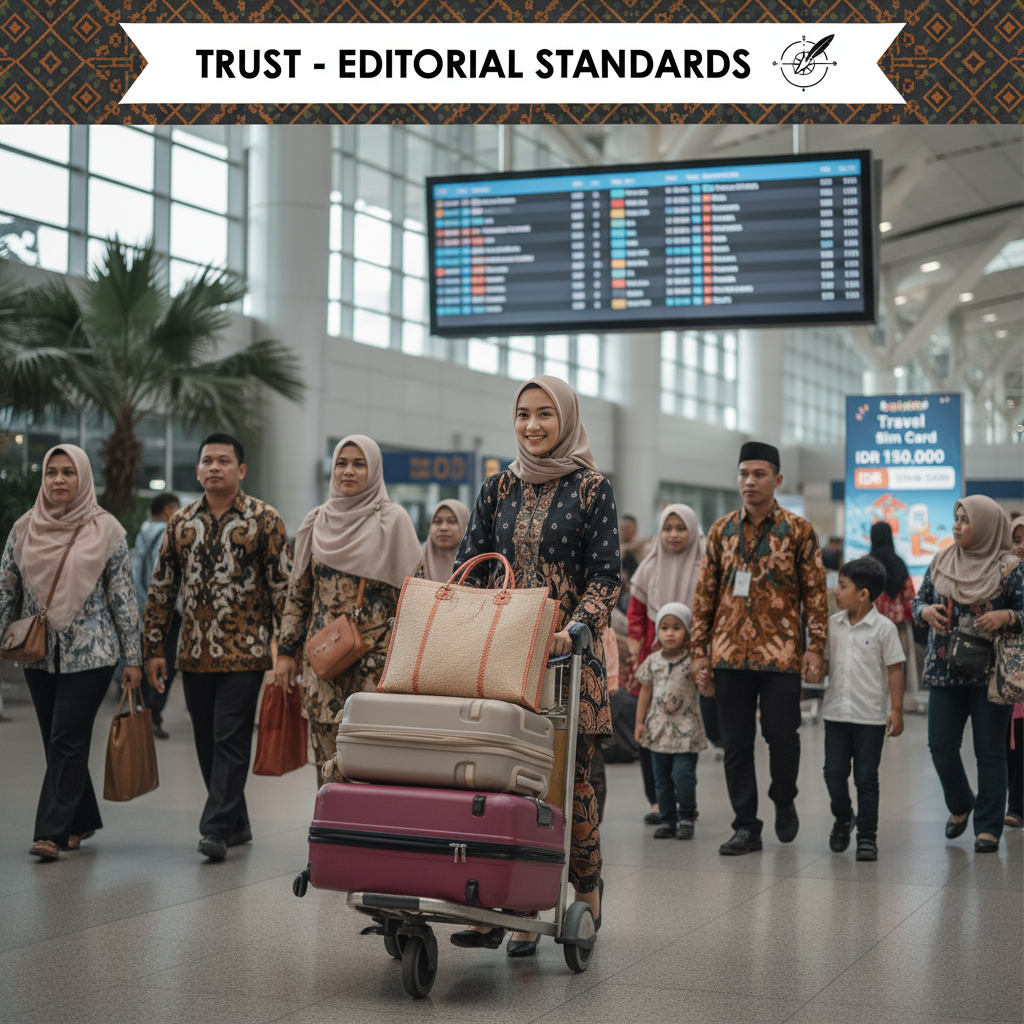
- No blonde-on-Bali stock imagery. All SkyIndoFly imagery is Indonesian-faces only. No generic Bali rice-terrace cliché, no white-couple-honeymoon, no AI-glossy-mosque (we use real airport photos, not stock).
- No religious-ruling interpretation on Umrah/Hajj content. Detailed in §2.
- No legal-prescriptive advice on PMI content. Detailed in §2.
- No USD-first pricing. Required format: “Rp 7,900,000 (~USD 500)”, not “USD 500 (~Rp 7,900,000)”. Exception: content specifically about foreign-currency pricing (e.g. SAR for Saudi visa fees) still includes the IDR parenthetical.
- No PPIU rankings. We describe what Kemenag SISKOPATUH lists — we do not rank PPIU ourselves.
- No Jakarta-elite slang on PMI content. Patterns like “Yo PMI Taiwan? Your ARC expiring, dude?” violate the respect-baseline for the East Java / Central Java / NTB / NTT majority of PMI.
5. Persona disclosure — collective byline
SkyIndoFly publishes every article under the single byline SkyIndoFly Editorial Team. Individual writers are not publicly identified. This policy rests on three rationales detailed on the about page:
- Source protection. PMI Desk editors maintain contacts at KDEI, KJRI, and former labor attachés. A collective byline provides distance from sensitive pieces. Several PMI field sources have explicitly asked not to be associated with public articles for fear of reprisal — even when they are willing to share procedural information that helps our audience.
- Voice consistency. Five voice registers across SkyIndoFly (Umrah formal-warm, PMI bilevel, Diaspora baku-with-en-ID-mix, Backpacker en-ID-heavy, Tools neutral) are already complex; adding personal-style whiplash per writer is counterproductive.
- Collective process accountability. Every YMYL article is verified by at least two desks: the author + Editorial Leadership. The single byline reflects editorial work, not solo authority claims.
Exception: long-form investigative pieces or collaborations with external contributors may carry a collaborative byline — but these are rare cases and will be explicitly flagged in the article header.
6. Cross-desk fact-check workflow
Every Tier 1 and Tier 2 YMYL article passes through this workflow:
- Originating-desk author — drafts the article, gathers citations, writes the disclaimer block.
- Cross-desk fact-check — an editor from a different desk reviews (e.g. Umrah Desk gets fact-checked by Editorial Leadership; PMI Desk gets fact-checked by Diaspora Desk on corridor-correspondence questions). The cross-checker reads with fresh eyes and verifies each citation by accessing the source URL directly.
- Editorial Leadership sign-off — final review for voice consistency within cluster, YMYL-disclaimer compliance, and anti-AI-ism format adherence. Sign-off is marked with the “Last verified” timestamp that appears adjacent to the H1.
- Publish + monitoring — articles enter a six-month review calendar. Visa rules, customs allowances, and airline policies are tracked for updates; significant changes trigger re-review.
7. Reader correction policy
If you find a factual error in a SkyIndoFly article — outdated pricing, changed visa rules, broken citations, typos, or inaccurate regulatory claims — we want to know.
How to report:
- Email: [email protected] (routes to Editorial Leadership)
- WhatsApp: see the contact page for the current number
- Correction form: available on the contact page
What happens after a report:
- Editorial Leadership verifies the claim within 48 working hours.
- If the claim is valid, the article is updated and a dated correction note is added at the end of the article. Format: “Correction 18 May 2026: paragraph 4 previously listed the Saudi e-visa fee as SAR 450; the current official figure is SAR 535. Updated with Saudi MOFA source.”
- If the claim is not verified, we respond to the reporter with an explanation and the citations that underpin the original content.
- The “Last verified” timestamp at the article’s H1 is updated.
We publish an annual public correction log summarizing how many corrections were received, how many were applied, and the most frequent error categories. The first log will be published in May 2027.
8. What we are not
To close ambiguity: SkyIndoFly is not:
- Not a travel agency. We do not sell tickets. You book directly on Aviasales/Travelpayouts.
- Not a PPIU (Umrah pilgrimage organizer). We do not organize Umrah packages. For the official PPIU directory, see Kemenag SISKOPATUH.
- Not a law firm or immigration consultancy. We do not give case-specific legal advice.
- Not an airline-sponsorship platform. We do not publish paid airline rankings.
- Not a religious-ruling publisher. We do not interpret syariah.
For full monetization transparency, see the affiliate transparency page.
Published by the SkyIndoFly Editorial Team. This standard takes effect 11 May 2026 and will be revised at least annually. Last verified: May 2026.